ArkUI Declarative UI Engine - HarmonyOS Pt.2
After exploring the Rosen Render Service in Part 1, we now move one layer up the stack to the declarative UI framework that developers actually use every day: ArkUI.
The engine behind it lives in the arkui_ace_engine repository (also mirrored on GitHub under openharmony).
What makes it special
The declarative layer in ArkUI is deliberately very thin. High-level ArkTS (or TypeScript/JavaScript) syntax is transpiled at build time into imperative code that drives a small set of native hooks. The overwhelming majority of work—component creation, tree management, layout, rendering, property updates, and event handling—executes in highly optimized C++.
This is a conscious performance decision. Even with modern JavaScript engines and JIT/AOT compilation, staying in native code for the hot paths (especially per-frame work) is dramatically more efficient. When running cross-platform on iOS, ArkUI’s component creation and layout times have consistently outperformed SwiftUI counterpart by 10%. The performance comes from avoiding JS object churn, direct bridging into C++, and node-level incremental updates.
Before transpilation (what you write)
Column() {
    Button("Click me") {
        // child content
    }
    .onClick(() => { ... })
    .width('100%')
    .aspectRatio(2.0)
}
After transpilation (what actually runs)
The ArkTS compiler transforms the declarative syntax into imperative calls wrapped in observeComponentCreation (or the optimized observeComponentCreation2) closures. These closures interact with ViewStackProcessor for ID allocation, dependency tracking, and stack-based tree construction.
Here’s a simplified illustration of the generated shape:
this.observeComponentCreation((elmtId, isInitialRender) => {
    ViewStackProcessor.StartGetAccessRecordingFor(elmtId);

    Column.create();
    // width / aspectRatio applied via ModelNG or ModifierWithKey path

    this.observeComponentCreation((childElmtId) => {
        ViewStackProcessor.StartGetAccessRecordingFor(childElmtId);
        Button.createWithLabel("Click me");
        Button.onClick(() => { ... });
        Button.pop();
        ViewStackProcessor.StopGetAccessRecording();
    }, Button);

    Column.pop();
    ViewStackProcessor.StopGetAccessRecording();
}, Column);
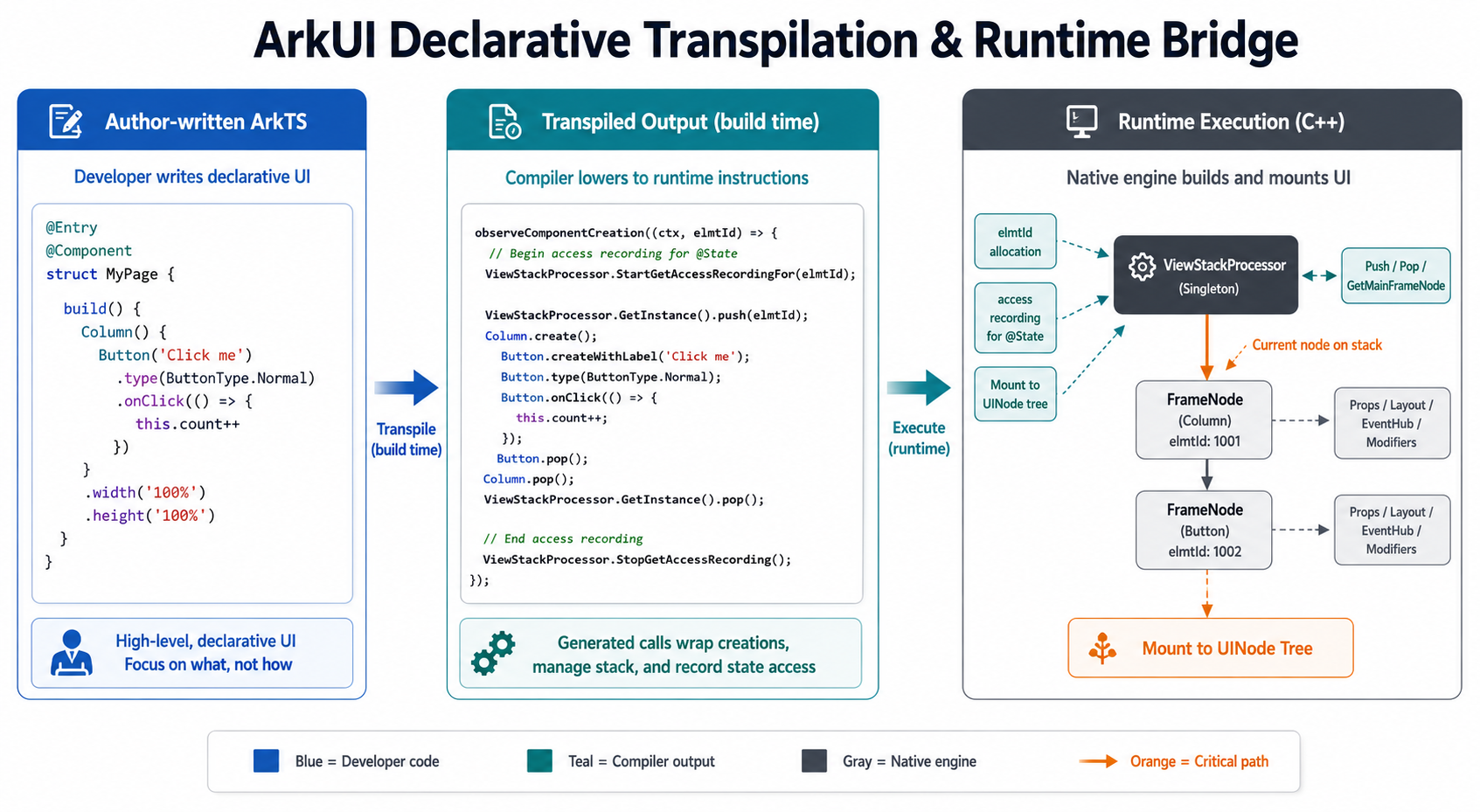
Figure 1: From TS to transpiled observeComponentCreation code that drives ViewStackProcessor and builds the native FrameNode tree.
There is no runtime interpretation of the nice declarative syntax you wrote. Every component creation flows through a tiny, well-defined bridge into C++.
Tree formation with ViewStackProcessor
ViewStackProcessor (see frameworks/core/components_ng/base/view_stack_processor.h) is the central singleton that owns the construction stack while declarative code executes:
GetInstance()StartGetAccessRecordingFor(elmtId)/StopGetAccessRecording()— records reads of state variables against the current element ID for fine-grained reactivity.Push(node),Pop(),PopContainer(),Finish()— builds the parent-child relationships.GetMainFrameNode()— the node that property setters (viaViewAbstractand the variousModelNGclasses) target.- Support for element IDs, keys (used by ForEach), visual states, implicit animations, and prebuild commands.
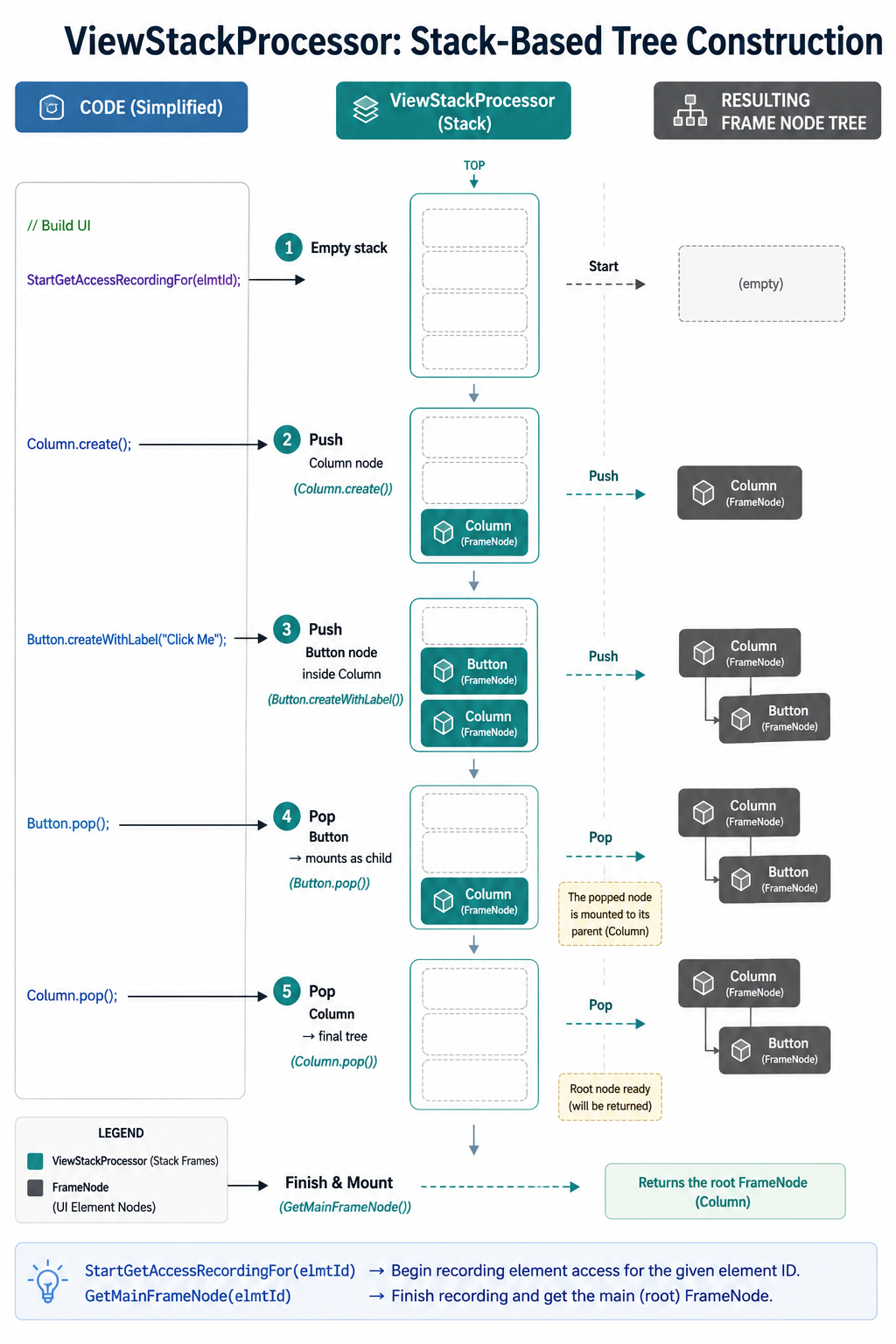
Figure 2: ViewStackProcessor maintains a construction stack that mirrors the nesting in your declarative code.
When your component’s build() (or equivalent) runs—whether on initial render or a targeted re-execution after a state change—it pushes nodes onto this stack. The pop/finish operations mount them into the real UINode / FrameNode tree and mark the work complete.
This mechanism is the direct counterpart to Jetpack Compose’s slot table / Composer or SwiftUI’s view builder internals, but wired straight into ArkUI’s retained C++ node tree.
Modules that remain (mostly) in the TS world
While the heavy lifting lives in C++, a few pieces stay in the higher-level language for developer experience and reactivity:
Decorators and state (@Component, @State, @Link, @Builder, @Prop, etc.)
The syntactic transformation and reactivity system are primarily the responsibility of the ArkTS compiler and the state management runtime. At execution time the engine only sees the observeComponentCreation* hooks plus access recording through ViewStackProcessor.
When a @State variable mutates, the state layer re-invokes only the affected observation closures. Inside those closures the element IDs and ViewStackProcessor allow the framework to reuse existing FrameNode instances instead of throwing everything away.
JSDataChangeListener and ElementRegister provide the native-side hooks that make data-driven updates (ForEach, LazyForEach, etc.) efficient.
Example: @Component + @State (conceptual)
  @Component
  struct MyCard {
      @State count: number = 0;

      build() {
          Column() {
              Text(`Count: ${this.count}`)
              Button("Inc").onClick(() => this.count++)
          }
      }
  }
The compiler turns the body of build() into an observeComponentCreation closure. Reads of this.count during the recording phase register the dependency against the current elmtId. Later mutation triggers a minimal re-execution of just that closure.
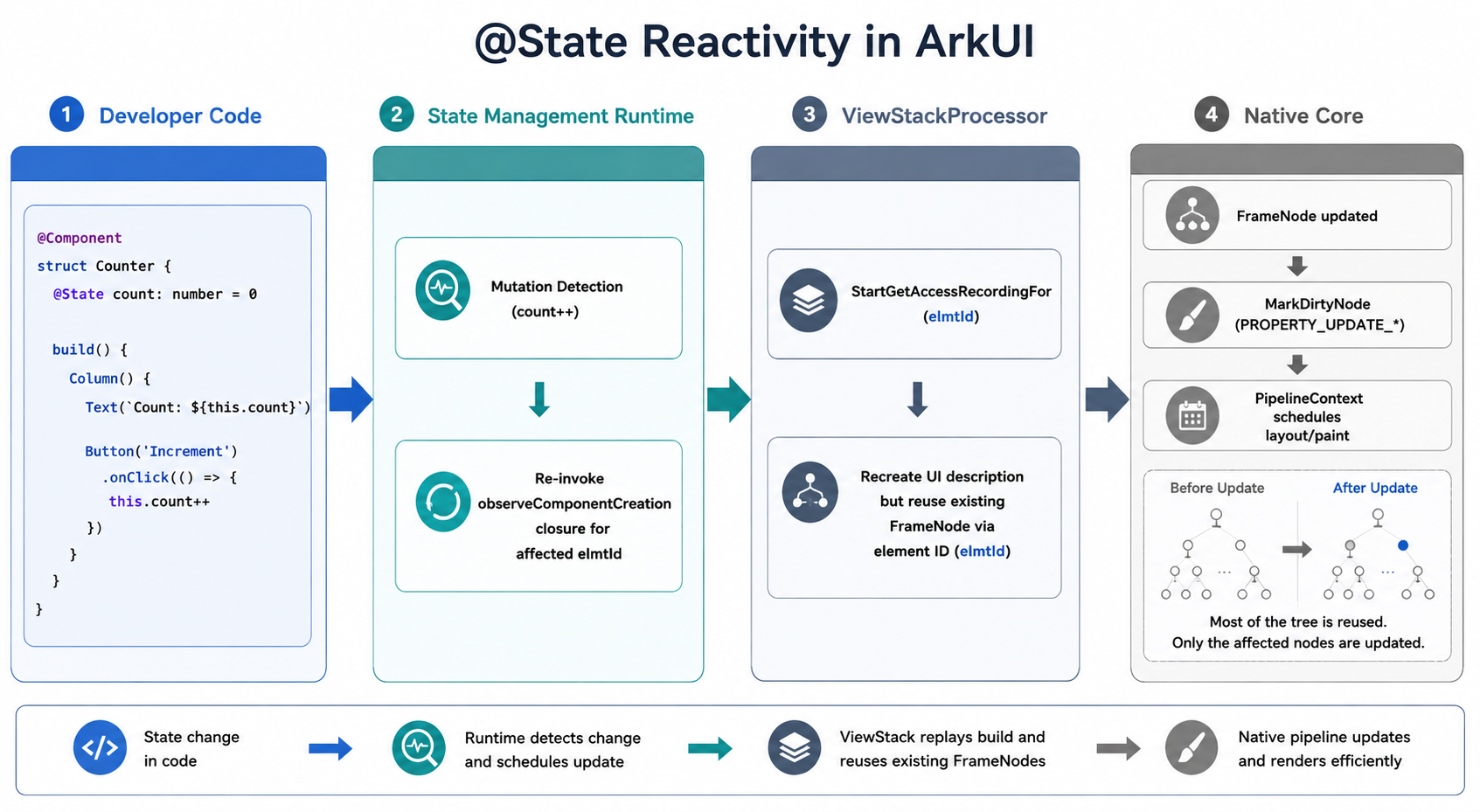
Figure 3: When a @State variable mutates, only the affected component closures are re-executed using element IDs for efficient updates.
LazyForEach (virtualized / lazy lists)
This has first-class support on both sides of the bridge (js_lazy_foreach.cpp in the declarative frontend and LazyForEachNode + LazyForEachBuilder in frameworks/core/components_ng/syntax/).
It uses the FrameProxy virtualization mechanism inside FrameNode for on-demand creation, caching, and eviction of children based on the visible range. The ArkTS side supplies the data and item builder; the C++ side owns the recycling and diffing. This is a great example of deliberately keeping generation logic close to the developer while the performance-critical tree management stays native.
Modifiers
Another important piece that stays lightweight in JavaScript is the Modifier system. This is what backs the fluent attribute calls developers write every day:
Button('Save')
  .width(160)
  .height(48)
  .backgroundColor(Color.Blue)
  .fontColor(Color.White)
  .borderRadius(8)
  .onClick(() => this.save())
For app authors, these calls feel like ordinary declarative styling and event binding. Under the hood, each chained call records a small modifier object against the current component. When state changes, ArkUI can compare the old and new modifier values and send only the changed native update instead of replaying every property blindly.
HarmonyOS also exposes this idea directly through attributeModifier(), which lets developers package reusable attribute logic into an AttributeModifier class:
class PrimaryButtonModifier implements AttributeModifier<ButtonAttribute> {
  applyNormalAttribute(instance: ButtonAttribute): void {
    instance
      .height(48)
      .backgroundColor(Color.Blue)
      .fontColor(Color.White)
      .borderRadius(8);
  }
}

Button('Save')
  .attributeModifier(new PrimaryButtonModifier())
  .onClick(() => this.save())
The internal implementation of a simple attribute like width is then just a thin bridge object:
class WidthModifier extends ModifierWithKey {
  applyPeer(node, reset) {
    if (reset) {
      getUINativeModule().common.resetWidth(node);
    } else {
      getUINativeModule().common.setWidth(node, this.value);
    }
  }
  checkObjectDiff() { /* ... */ }
}
This design allows cheap structural diffing on the JS side for state-driven updates before any native call is made. The developer sees reusable declarative attributes; the engine sees keyed modifier objects that can be compared, reset, and applied through arkUINativeModule.
Cross platform by design
The architecture was built with multiple frontends and backends in mind:
- Frontends: The main declarative path (ArkTS/TS/JS via the
declarative_frontend/bridge and JSI), experimental ArkTS variants, Cangjie, and a full C/C++ Native API surface (OH_ArkUI_*functions + the Arkoala API). - Rendering backends: The primary backend is Rosen (
RosenRenderContextwrappingRSNode). The design keeps a clean abstraction layer (there are also references to Skia in the broader ecosystem). - Platform adapters:
adapter/ohos/, a previewer mode, and the cross-platform ports that allow the same core to run on Android and iOS.
All paths—whether you write ArkTS with @Component or call the native C API directly—converge on the same FrameNode + Pattern + LayoutProperty/PaintProperty core, and ultimately the same PipelineContext and render backend.
This is why ArkUI can deliver a consistent, high-performance declarative model across HarmonyOS devices, Android, and iOS from a single C++ implementation.
Summary
ArkUI’s declarative engine achieves its performance by:
- Making the TS layer a thin transpiled bridge.
- Driving almost everything through
ViewStackProcessor+ModelNGinto nativeFrameNode/Patternobjects. - Using element IDs + access recording for precise, incremental state updates.
- Keeping only the developer-facing ergonomics (decorators, builders, lazy item generation) in the higher-level language.
- Maintaining a clean multi-frontend / multi-backend architecture.
The result is a system that feels like a modern declarative UI framework while executing with the efficiency of a native rendering engine.
In future parts we’ll go deeper into the FrameNode + Pattern composition model, the dirty propagation and layout/paint pipeline, how LazyForEach and virtual scrolling actually work at the node level, and the raw C interface. Or we’ll get back to the render service and talk about various low-level optimizations there.